300x85-png.webp)


 Hong Kong
 Singapore
 China
China Dubai
Dubai Thailand
 United Kingdom
 Mexico
Navigating GERD while living abroad as an expat requires careful planning and full transparency, especially with health insurance.
Discover the world’s top
health insurers.
Compare quotes with
a click of the button.
Some insurers may exclude coverage for pre-existing conditions like GERD, depending on the provider and plan level, making it vital for expats to compare options and review their policy thoroughly.
In this Pacific Prime article, we explore how GERD, or gastric reflux, affects health insurance by looking at underwriting practices, its impact on premiums, available plan options, and coverage details. We also share tips to help expats with GERD choose the right insurance plan abroad.
Understanding GERD (Gastroesophageal Reflux Disease) or Gastric Reflux
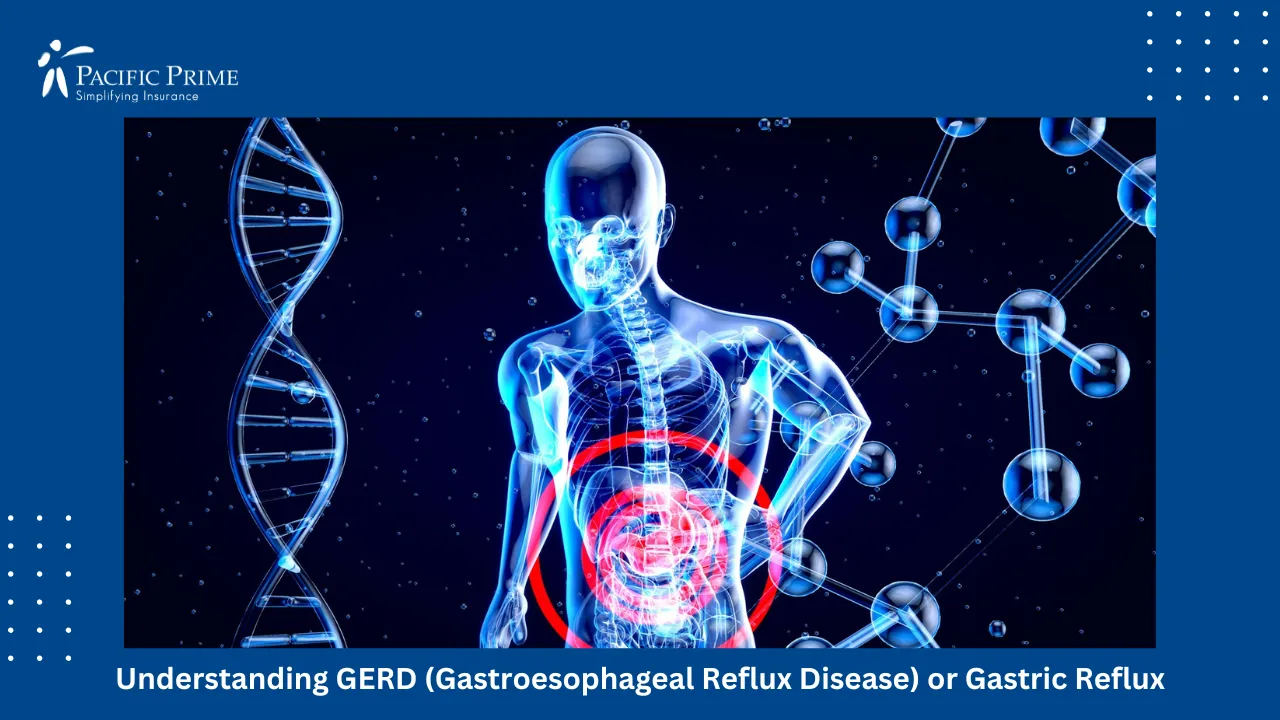
Gastroesophageal reflux disease (GERD) is a chronic condition where stomach acid flows back into the esophagus, causing heartburn. Occasional acid reflux is common, but when it occurs repeatedly over time, it is classified as GERD.
Common symptoms for GERD include:
- Heartburn (a burning sensation in your chest, which typically occurs after eating or at night when lying down)
- Upper belly or chest pain
- Dysphagia (trouble swallowing)
- Backwash of food, liquid, or sour acid in the throat
- Nausea
- Worsening asthma symptoms, such as coughing, wheezing, or shortness of breath
These symptoms typically worsen at night, while lying down, after a large fatty meal, after bending over, or after smoking or drinking alcohol.
Diagnosis Methods for GERD
To diagnose GERD, a gastroenterologist may use:
- Esophagram: X-ray of the esophagus while swallowing barium.
- Upper endoscopy: Camera inserted via the mouth to examine the esophagus, stomach, and duodenum.
- Esophageal pH test: Measures acid levels in the esophagus.
- Esophageal manometry: Assesses muscle and LES function with pressure sensors.
Why GERD Management is Important
If left untreated, long-lasting GERD symptoms can lead to an injury of the esophagus and other organs, resulting in many possible complications, including:
- Esophagitis: Inflammation of the esophagus lining.
- Barrett’s esophagus: Damaged esophagus lining, raising cancer risk.
- Esophageal stricture: Narrowing of the esophagus, affecting swallowing.
- Laryngopharyngeal reflux: Acid reaching the throat, causing irritation.
- Asthma: Acid may trigger coughing or breathing difficulties.
To prevent these complications, GERD and acid reflux should be managed promptly through lifestyle changes or by consulting a doctor.
How GERD or Gastric Reflux Affects Expat Health Insurance
Insurance providers typically consider GERD, or gastric reflux, a pre-existing condition when assessing your health and medical history. This can affect your coverage and premiums depending on the severity, treatment history, and the insurer’s policies.
Understanding Pre-Existing Conditions
In international health insurance, pre-existing conditions refer to any medical condition, illness, or injury that manifested symptoms before the start date of your new policy, regardless of whether you received treatment.
Insurance companies generally require disclosure of GERD during the application process. The severity of GERD, symptom management, complications (such as esophagitis or Barrett’s esophagus), and treatment history will influence the underwriting decision.
Underwriting Approaches
Insurers handle GERD using two common types of medical underwriting: full medical underwriting and moratorium writing.
- Full Medical Underwriting (FMU)
This approach requires applicants to fully disclose their medical history when applying. The insurer reviews conditions such as GERD to assess risk and may:
- Accept the application as standard
- Exclude GERD from coverage
- Accept with increased premiums to cover potential GERD-related costs
- Deny the application if the risk is deemed too high
- Moratorium Underwriting
No full medical history disclosure is required at application for moratorium underwriting. Still, pre-existing conditions such as GERD will initially be excluded for a specified waiting period (typically 2 years). If you remain symptom-free and untreated during the period, coverage may then begin.
However, claims can take longer to process, as underwriting will happen at the point of claim to verify if a condition is pre-existing.
Impact on Health Insurance Premiums
In many cases, the insurers will provide coverage for your pre-existing condition, like GERD, while raising your premium rates to cover the medical costs that may arise from treatment and complications related to GERD.
Other factors that could indirectly influence premiums include overall health, lifestyle, and any coexisting conditions that may affect the insurer’s long-term risk.
Coverage for GERD Management on Expat Insurance
Coverage for GERD management varies by policy and insurer, but comprehensive international health insurance typically supports extensive medical services, from diagnosis and medication to surgery if medically required.
GERD management coverage may include:
- Doctor visits and specialist consultations for diagnosis and ongoing management of GERD symptoms.
- Diagnostic tests such as endoscopy, esophageal pH monitoring, and manometry are used to assess the severity and impact of GERD.
- Medications, including:
- Proton Pump Inhibitors (PPIs) like omeprazole and esomeprazole,
- H2 blockers, such as ranitidine or famotidine,
- Antacids and prokinetic agents as prescribed by your doctor.
- Lifestyle counseling, such as dietary and behavioral changes, to reduce reflux symptoms.
- Surgical treatments for severe GERD cases, often covered if deemed medically necessary, including:
- Laparoscopic fundoplication,
- Transoral incisionless fundoplication (TIF),
- LINX device implantation (magnetic sphincter augmentation),
- Other advanced endoscopic procedures like Stretta therapy or EsophyX.
- Hospitalization and postoperative care related to GERD surgeries or complications.
Navigating Health Insurance for Expats with GERD or Gastric Reflux
As an expat with such a pre-existing condition as GERD, it’s important to understand your plan, from enrollment and coverage for medications to prior authorizations and appealing denied claims.
Choosing the Right Plan for Chronic Condition Management
To choose the right plan, expats with chronic conditions should evaluate coverage options, costs, and support services. Since not all policies treat chronic conditions equally, here is a checklist of what to look for when reviewing your health insurance options:
- Coverage of pre-existing conditions: Check if GERD is covered, or if premium loading and a waiting period are applied.
- Prescription drug benefits: Confirm if your options include coverage for medications (both inpatient and outpatient).
- Specialist access: Ensure you can see gastroenterologists or related specialists without unnecessary barriers.
- Chronic condition support: Look for disease management programs or wellness support tailored to ongoing conditions.
- Out-of-pocket costs: Review deductibles, copayments, and coinsurance for consultations, tests, and treatments.
- Global coverage: Verify that your plan provides care both in your host country and abroad if you travel frequently.
Why Disclosing GERD Matters at Enrollment
It’s important to disclose any pre-existing conditions, including GERD, honestly to ensure you’re matched with the right plan for your needs and help prevent future issues such as rejected claims or even having your policy cancelled.
Being transparent about your medical history also provides peace of mind, allowing insurers to approve ongoing treatment in advance and giving you confidence in your coverage.
Understanding Your Plan’s Formulary for GERD Medications and Supplies
A plan formulary is a tiered list of medications showing which drugs are covered and at what cost. For GERD, understanding these tiers—such as generic versus brand-name—ensures your prescriptions are approved and helps avoid unexpected out-of-pocket costs.
Common GERD medications (PPIs, H2 blockers, antacids, and prokinetics) are generally categorized as:
- Tier 1: Preferred generic drugs
- Tier 2: Generic drugs
- Tier 3: Preferred brand drugs
- Tier 4: Non-preferred brand drugs
- Tier 5: Specialty tier drugs
Prior Authorization
Some treatments or medications may require insurer approval in advance, known as prior authorization, to avoid denied claims. Common examples include:
- Medications that could be unsafe when combined with others
- Treatments with lower-cost, equally effective alternatives
- Treatments or medications limited to specific health conditions
- Medications or procedures prone to misuse or abuse
- Drugs often used for cosmetic purposes
Typically, in-network providers handle prior authorization on your behalf, while for out-of-network providers, you are responsible for obtaining it yourself. This process usually takes 5–10 business days.
Handling Denied Claims for GERD Care
When your medical claim is denied, you should first understand the reason for the denial stated in your EOB (Explanation of Benefits) or denial letter, and you may appeal to the insurer within the given timeframe to protect your rights.
Here are the strategies for appealing denied claims:
- Identify the reason for denial: Common causes include data entry errors, treatment deemed not medically necessary, off-formulary medications, out-of-network care, excluded services, or exceeding benefit limits.
- Craft your letter strategically: Address the insurer’s reason for denial directly, explain your condition, and outline why the treatment is necessary.
- Strengthen your case with supporting documents: Address the insurer’s reason for denial directly, explain your condition, and outline why the treatment is necessary.
- Stay persistent: Keep copies of all documents, track communications, and continue appealing if denied again—many appeals succeed with persistence.
Best International Health Insurance Providers for Expats with GERD
Providers like IMG, Cigna Global, Allianz, Bupa Global, and GeoBlue offer some of the top international health insurance options for expats with GERD. Their plans are known for comprehensive coverage and strong support for managing chronic conditions.
IMG for Expats with GERD
IMG’s Global Medical international health insurance plan stands out for its pre-existing conditions waiver, which allows coverage without the 24-month waiting period if you had prior health insurance with no gaps longer than 63 days.
The Global Medical Silver, Gold, and Platinum options, particularly, include pre-existing condition coverage.
- Global Medical Silver: USD $5,000,000, with comprehensive coverage for inpatient and outpatient treatment and medical evacuation.
- Global Medical Gold: USD $5,000,000, with greater coverage for room fees, specialist visits, diagnostic tests, dental treatment, and more.
- Global Medical Platinum: USD $8,000,000, offering maternity and newborn care, preventative care, mental health services, and more.
| Pre-Existing Conditions | Silver | Gold | Platinum |
| Known disclosed conditions | Covered the same as any illness or injury unless excluded by a Rider | Covered the same as any illness or injury unless excluded by a Rider | Covered if disclosed and not
excluded by rider |
| Nondisclosed conditions | N/A | N/A | Covered if disclosed and not
excluded by rider |
| Unknown conditions
(After 24 months of continuous coverage) |
Period of Coverage: $5,000
Lifetime Maximum: $50,000 |
Period of Coverage: $5,000
Lifetime Maximum: $50,000 |
Covered if disclosed and not
excluded by rider |
With an IMG plan, expats with GERD as a pre-existing condition can receive immediate coverage if they qualify for the waiver through prior continuous insurance
Cigna Global for Expats with GERD
Cigna offers personalized international health insurance designed for expats with three tiers of coverage that vary in both annual limits and range of benefits:
- Cigna Silver: USD $1,000,000, covering essential inpatient and day-patient care.
- Cigna Gold: USD $2,000,000, with a wider range of maternity and newborn benefits
- Cigna Platinum: Unlimited, covering most inpatient services in full.
For GERD patients, all Cigna plans include the Chronic Condition Program, which supports managing long-term conditions. Expats can also add health and well-being riders that offer wellness coaching and dietetic consultations, helping manage GERD through lifestyle and dietary changes.
Other available add-ons include outpatient care (important for regular specialist visits and prescriptions), medical evacuation and repatriation, and vision and dental care.
Allianz for Expats with GERD
International health plans by Allianz are modular, so expats can customize coverage to their needs, with three options available: Care, Care Plus, and Care Pro.
Here is the summary of their plan offerings:
- Care: USD $2,500,000, covering the essential inpatient and expat-specific benefits.
- Care Plus: USD $4,000,000, with additional benefits of emergency outpatient treatment and outpatient dental treatment.
- Care Pro: USD $5,000,000, including basic benefits and preventive surgery, laser eye treatment, and accidental death.
Additionally, Allianz’s outpatient rider offers valuable coverage for GERD management, including visits to medical practitioners and specialists, prescription medications, and diagnostic tests.
Bupa Global for Expats with GERD
Bupa Global is a highly reputable insurance provider, offering premium international health insurance for expats worldwide.
Expats can choose from four distinct plan levels: Select, Premier, Elite, and Major Medical—each designed to meet different healthcare needs and budgets.
- Select: USD ~$1,587,100, covering essential outpatient and inpatient care, including day-to-day care and surgery costs.
- Premier: USD ~$2,380,600, including regular check-ups, dental treatment, and a wider range of outpatient benefits.
- Elite: USD ~$4,761,300, catering to families with assisted fertility and maternity cover after 18 months.
- Major Medical: USD ~$3,174,200, focusing on covering sudden unexpected emergencies and major medical expenses and excluding wellness and routine appointments.
Bupa Global provides coverage for pre-existing conditions, subject to medical underwriting and approval. Therefore, it is important to disclose your pre-existing condition, including GERD, for the insurer’s review.
GeoBlue for Expats with GERD
GeoBlue provides extensive international coverage for American expats, featuring unlimited benefit limits and immediate inclusion of pre-existing conditions with proof of prior coverage. A key advantage is its strong U.S. coverage, offered through two core plans:
- Xplorer Premier offers worldwide coverage, including the U.S., where 80% coinsurance applies for in-network treatment. It also allows policyholders to travel to the U.S. specifically for medical care.
- Xplorer Essential covers care received outside the U.S. only, with the option to add limited U.S. coverage for short-term illness, accidents, and emergencies.
Outside the U.S., basic benefits fully cover primary and preventive care, inpatient services, surgery expenses, diagnostic tests, ambulance service, in- and outpatient mental health, prescription drugs, medical evacuation, and pre-existing conditions.
American expats with pre-existing conditions such as GERD may receive coverage immediately under GeoBlue, provided they can show proof of prior continuous health insurance.
Tips for Choosing Expat Insurance with GERD
For expats with GERD, the key is finding comprehensive protection that will ensure continuous access to necessary treatments, medications, and specialist care wherever you are living. Here are a few tips to help you choose the right international health insurance plan:
- Be honest and transparent: Full disclosure is paramount to avoid future claim denials. Attempting to hide pre-existing conditions will void your policy and leave you financially exposed.
- Compare underwriting philosophies: Look for insurers known for more lenient approaches to pre-existing conditions, if possible.
- Review policy wordings carefully: Pay close attention to sections on pre-existing conditions, exclusions, waiting periods, and formularies.
- Check network and direct billing: Confirm the insurer has gastroenterologists and hospitals in your destination country that accept direct billing. This prevents out-of-pocket expenses for regular check-ups, medication refills, or emergency flare-ups.
- Consider emergency evacuation: While rare, GERD can lead to serious complications like severe bleeding, perforation, or aspiration pneumonia that may require specialized treatment unavailable locally. Ensure your policy includes medical evacuation with adequate coverage limits.
- Seek expert advice: Consult an international health insurance broker, like Pacific Prime, who understands the complexities of covering chronic conditions abroad. Experienced brokers can compare plans from multiple providers to help you find the right coverage with the best value.
Secure Your Expat Insurance Coverage with Pacific Prime
Living abroad with GERD requires careful consideration when selecting international health insurance. While GERD is generally manageable, it’s classified as a pre-existing condition that can affect coverage options and premiums.
With over 20 years of experience, Pacific Prime helps expats with diverse healthcare needs, including those with pre-existing conditions, find the right coverage for their time abroad—whether it’s international health insurance, family plans, or short-term policies.
Contact us today for a FREE quote comparison and expert, impartial advice.
Frequently Asked Questions
Is GERD covered under insurance?
GERD can be covered under insurance, depending on the provider, plan, and medical underwriting. Some international health plans cover GERD immediately with proof of prior insurance, while others may impose waiting periods or limits for pre-existing conditions.
Does GERD require a medical diagnosis?
GERD should be confirmed through a medical diagnosis, often using tests like endoscopy, pH monitoring, or esophageal manometry to evaluate acid reflux and esophageal function. A formal diagnosis is important for treatment planning and insurance coverage.
Can you travel with GERD?
Traveling with GERD is manageable if expats bring necessary medications, plan meals to avoid triggers, stay hydrated, and ensure their international health insurance covers treatment abroad to handle symptoms during unexpected incidents while living or traveling overseas.
How do I compare plans for GERD coverage abroad?
When comparing GERD coverage abroad, consider pre-existing condition policies, waiting periods, medication formularies, access to specialists, and international coverage. Working with an experienced broker or using a plan comparison tool can help identify the plan that best meets your needs.
What happens if a GERD claim is denied?
If a GERD claim is denied, it’s often due to non-disclosure, coverage exclusions, or missing documentation. Policyholders can appeal by submitting additional medical records, clarification from their doctor, or supporting evidence to help the insurer reassess the claim.
- Thailand Digital Nomad Visa 2025: How to Apply – October 20, 2025
- Top Health Insurance in Thailand for Spanish Expats: Options and Benefits – October 20, 2025
- Arab Orient Insurance and GIG Health Insurance for Expats in Dubai – October 15, 2025



Comments