300x85-png.webp)


 Hong Kong
 Singapore
 China
China Dubai
Dubai Thailand
 United Kingdom
 Mexico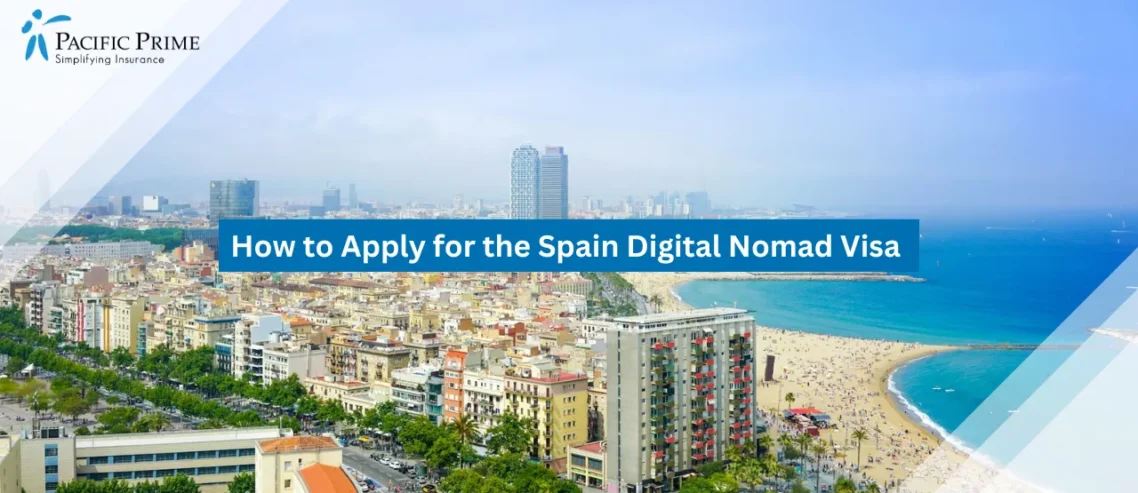
Applying for the Spain Digital Nomad Visa involves several key steps: gathering the required documents, submitting your application, receiving the approved visa, and registering for a residence card (TIE) to complete the process.
Discover the world’s top
health insurers.
Compare quotes with
a click of the button.
While the procedure may seem complex at first, it can be navigated smoothly with proper planning and preparation.
In this Pacific Prime article, we offer a comprehensive guide to the Spain Digital Nomad Visa, covering eligibility criteria, required documents, and step-by-step instructions. We also highlight the importance of securing health insurance during your stay in Spain.
To explore whether Spain is the right destination for you, read our article: Is Spain a Good Country for Digital Nomads? Pros and Cons.
Understanding the Spain Digital Nomad Visa
Spain has introduced the Digital Nomad Visa under the Startup Law, aiming to attract global talent. This visa allows non-EU/EEA citizens to live in Spain while working remotely, either as an employee for a company based outside the country or as a freelancer with international clients.
The validity length—either one or three years, with the option to renew—and the application process will depend on whether you apply from within Spain or through a Spanish embassy abroad, as each route has its own set of procedures.
Benefits of the Spain Digital Nomad Visa
This visa not only grants you legal access to Spain’s high quality of life and affordable living costs but also comes with several exclusive advantages:
- Lower taxes
While digital nomads are considered tax residents in Spain, some visa holders may qualify for a reduced flat tax rate of 24% on income up to €600,000 (USD ~$706,663) under the Beckham Law.
This special program is available to those working as employees for foreign companies and who have not been tax residents in Spain for the past five years. It exempts eligible applicants from the standard progressive tax rate, which can go up to 50%.
In addition, Spain has double taxation agreements, helping prevent you from being double taxed for the same income, with over 90 countries, including the United States, the United Kingdom, Canada, Australia, New Zealand, and most European countries.
- Eligibility for permanent residency
Digital nomads can apply for a Spanish permanent residency (long-term residence) after five years of legally holding the digital nomad visa. If you meet the residency requirements, you can apply for Spanish citizenship after 10 years.
- Family inclusivity
Family members of the visa holders are also eligible for residence permits, with their children getting access to Spanish public education.
Who Can Apply for Spain’s Digital Nomad Visa?
The Spain Digital Nomad Visa is open to non-EU/EEA nationals who wish to live in Spain while working remotely for a foreign employer, as freelancers, or as self-employed individuals.
Eligibility criteria include:
- Nationality: Only non-EU/EEA citizens can apply. Citizens of EU/EEA countries do not need this visa to work remotely in Spain.
- Remote work status: Applicants must work remotely for a company or clients located outside of Spain. Freelancers and self-employed individuals are also eligible, but no more than 20% of their income can come from Spanish clients.
- Employment history: You must be employed or under contract for at least three months prior to the application, while your employer or main client must have been operating in the market for over one year.
- Academic/professional profile: Applicants must have a university degree, a professional certificate, or at least three years of work experience in their relevant field.
- Financial requirements: Applicants must be able to have sufficient monthly income to support themselves/family members/dependents while living abroad in Spain. The minimum income thresholds are as follows:
-
-
- Individual: €2,763 (USD ~$3,255)
- Couples: €3,797 combined (USD ~$4,472.5)
- Each adult dependent: Additional €1,035 (USD ~$1,220)
- Each minor dependent: Additional €346 (USD ~$408)
-
- Criminal record: You must have a clean criminal record issued by your country of residence for the past five years.
- Health insurance: Applicants must hold comprehensive health insurance valid in Spain.
Visa Fees and Costs for the Spain Digital Nomad Visa
The total costs for the Spain Digital Nomad Visa for a single person are generally between €200 and €400. This number, however, will vary depending on your country of origin, document requirements, and other additional services, such as translation and legal assistance.
Typical mandatory costs for the Spain Digital Nomad Visa include the visa application fee, residence card (TIE) fee, NIE administration fee, health insurance, and other document-related expenses. Below is a breakdown of the key expenses:
- Visa application fee
-
- Apply from local consulates outside Spain: Around €80–90 (USD ~$94–106), varies by country
- Apply digitally through UGE-CE within Spain: €73.26 (USD ~$86)
- Residence card (TIE): around €17 (USD ~$20)
- NIE application: around €10 (USD ~$12)
Other costs, such as health insurance and documentation services, will vary depending on your country of origin and chosen service providers.
Required Documents
Document preparation is one of the most important processes in the Spain Digital Nomad Visa application. Missing, incomplete, or inaccurate paperwork can result in delays or even visa refusal. Below is a comprehensive list of the required documents for all applicants.
- Visa application form: Duly completed and signed.
- Valid passport and its copy: The passport must be valid for at least one year with at least two blank pages.
- Passport-sized photo: A recent (not more than six months old) passport-sized color photo with a light background, full-face view, and no sunglasses or face-covering garments.
- Proof of remote work or freelance: A certificate/letter issued by the company or your client, stating the following details:
- For employees
-
-
-
- Your current job title and salary
- Proof that you have been employed at the company for at least three months
- Confirmation that the company has been operating for at least one year
- A letter from your employer explicitly authorizing you to work remotely from Spain
- A certificate of social security coverage
-
-
- For freelancers and self-employed individuals
-
-
-
- Contracts with at least one international client
- Documentation confirming that no more than 20% of your income comes from Spanish sources
- A letter from a client confirming your remote work arrangement from Spain
-
-
- Proof of financial means
- Bank statements from the last three to six months
- Tax returns or recent slips
- Employment contracts stating your annual salary in euros
- Proof of academic/professional profile: Either a university certificate, degree, or proof of work experience for at least three years in your professional field
- Proof of accommodation in Spain: Evidence of where you will stay, such as a rental contract, property ownership document, or confirmed hotel/Airbnb reservation.
- Curriculum Vitae (CV)
- Criminal record certificate
- The original and a copy of a clean criminal record certificate issued by your country of origin for the past two years.
- A responsible declaration verifying the absence of criminal records for the previous five years.
- Health insurance policy: The original certificate and a copy of your insurance policy.
The insurance plan must be issued by an authorized insurance provider in Spain and must provide full coverage, without copayments, for medical services, including emergencies, hospitalizations, outpatient treatment, and repatriation, with validity throughout your stay there.
Check out our article on the Top 10 Health Insurance Providers for Expats in Spain to explore your options.
- Visa fee payment receipt
- NIE (Número de Identidad de Extranjero): This is only required if you are applying for the visa from within Spain.
Additional Documents for Family Members
For applicants bringing family members, additional documents may be required as follows:
- Marriage certificate
- Birth certificate
- Proof of dependency
Documents Translation and Apostille
For the Spain Digital Nomad Visa application, certain key documents must be apostilled and translated into Spanish by a sworn translator to be legally valid and accepted by Spanish authorities.
Documents Requiring an Apostille
- Criminal record certificate
- Marriage certificate and birth certificates (only if you are including family members in your application)
- University degree or professional qualifications
- Tax and social security documents
Documents Requiring a Sworn Translation into Spanish
- All the above apostilled documents, if they are not originally in Spanish
- Employment contract
- Employer/client letter
Step-by-Step Instructions to Applying for the Spain Digital Nomad Visa
There are two different routes you may take to apply for the Spain Digital Nomad Visa. While applying directly from within Spain gives you faster processing time and grants you longer visa validity than applying from abroad, it requires traveling before your visa approval.
Option 1: Apply at a Local Consulate Outside of Spain
If you are from outside Spain, the main application process will be completed at your local Spanish consulate or embassy. This route will grant you a one-year visa validity period.
Step 1: Prepare all the required documents
Follow the list of required documents and ensure that they are translated and apostilled.
This process should begin three to four months before your intended travel date, as obtaining apostilles and translations can take several weeks, depending on your country.
For instance, while an FBI background check in the US may take a few business days, the standard apostille process can take two to eight weeks.
Step 2: Book an appointment at the consulate or embassy
Check your local consulate’s or embassy’s website to book an appointment. Depending on demand and location, book early in advance since there are limited time slots.
Step 3: Submit your application at the embassy
Bring all the required documents and pay the visa application fee here.
Step 4: Wait for visa processing
The typical processing time is between 15 and 45 business days after you submit the application. However, some reported receiving a decision as early as between 10 and 20 days. If additional documents are required, the embassy may contact you through your email and extend the process.
Step 5: Receive your visa and travel to Spain
Once approved, your passport with a one-year digital nomad visa will be available for pickup at the embassy or delivery by mail. You’ll need to enter Spain within 90 days of the issue date.
Step 6: Apply for TIE or residence card in Spain
You must apply for your TIE (Tarjeta de Identidad de Extranjero) at the Extranjería (Foreigner’s Office) or National Police Station within 30 days of arrival.
It is recommended that you schedule an appointment through their website as soon as possible, as there are limited timeslots and the booking system may not always function smoothly.
Option 2: Apply Digitally Through the UGE Within Spain
If you have already entered Spain on a tourist visa, you may apply for the Digital Nomad Visa within three months through the online system of UGE-CE. Through this type of application, digital nomads will be granted a three-year visa validity period.
Step 1: Enter Spain on a tourist visa
Citizens of many countries—including the US, UK, Canada, Australia, and others—can enter Spain without a visa for up to 90 days. You must begin your Digital Nomad Visa application before this period ends.
On the other hand, citizens of nations that do not have visa exemptions must apply for a Schengen visa before traveling to Spain.
Step 2: Obtain an NIE (Foreigner Identity Number) and Digital Certificate
- The NIE (Número de Identidad de Extranjero) is essential for many formal procedures in Spain. It can be obtained by booking an appointment in advance at the Foreigners’ Office (Oficina de Extranjeros) or the local police station (Comisaría de Policía).
- A Digital Certificate (Certificado Digital) is necessary for online government applications. If you prefer to submit the documents to the UGE by yourself, a digital certificate must first be obtained from Fábrica Nacional de Moneda y Timbre (FNMT).
Another popular option is to hire an immigration lawyer, law firm, or agency that is an expert in navigating the Spanish bureaucracy system to assist with the process.
Step 3: Submit your application online through the UGE
The documents can be submitted digitally through the UGE-CE (Large Business Unit) online portal.
Step 4: Wait for visa processing
The processing time for this step is 20–30 working days, which is relatively faster than applying through the local embassy outside of Spain.
Step 5: Apply for TIE or residence card in Spain
You must apply for your TIE (Tarjeta de Identidad de Extranjero) at the Extranjería (Foreigner’s Office) or National Police Station within 30 days of the visa approval date.
As mentioned, it is best to book your appointment on their website early, as slots are limited and the system can be unreliable.
Common Mistakes to Avoid
Applying for the Spain Digital Nomad Visa may seem demanding, but with the right information and preparation, the process is entirely achievable. Here are some common mistakes to avoid.
- Incomplete or inaccurate documentation
Missing, outdated, or improperly prepared documents can lead to delays or rejection. - Applying too late
Some steps, like obtaining apostilles or translations, can take weeks. Start early to avoid unnecessary stress. - Ignoring regional differences
Procedures and timelines may vary slightly between consulates and regions in Spain. Always check the specific requirements for your location. - Overlooking health insurance requirements
Comprehensive private health insurance is mandatory. Make sure your policy meets the visa criteria and is valid for your entire stay. - Relying on unverified sources
Depending solely on unofficial or outdated information may cause you to miss critical requirements or deadlines. We recommend referring again to official government websites or consulting a trusted immigration professional.
Before making the move, it’s also important to understand the financial side of living abroad. For a clearer picture of what to expect, check out our article: Cost of Living in Spain for Digital Nomads: City-by-City Breakdown.
Secure Your Health Insurance With Pacific Prime
Applying for the Spain Digital Nomad Visa requires careful planning, but it is a crucial step toward starting a new chapter in Spain. As comprehensive health insurance is a key requirement, choosing a plan that suits both your budget and coverage needs is essential.
Pacific Prime is a trusted insurance brokerage with 25 years of experience. We help clients around the world make well-informed decisions when selecting expat health insurance, international health insurance, or family insurance plans.
Still unsure which health insurance plan is right for your stay in Spain? Contact us today for impartial advice and a FREE quote comparison.
Frequently Asked Questions
How do you qualify for a Digital Nomad Visa in Spain?
To qualify, you must work remotely for a non-Spanish company or foreign clients and earn at least €2,763 per month. You also need to show 3 months of work history, have private health insurance, and have a clean criminal record, along with supporting documents like contracts or agreements.
Do I have to pay tax in Spain on a Digital Nomad Visa?
Digital nomads must pay tax in Spain, as they are considered tax residents under this visa. While the standard income tax uses a progressive rate that can reach up to 50%, eligible digital nomads can apply for a special tax regime that offers a flat 24% rate on income up to €600,000.
How long can I be out of Spain on a Digital Nomad Visa?
You can be outside Spain for a maximum of six months or 183 days within a calendar year without losing your residence permit. However, travel within the EU or the Schengen Area does not count as an absence for residency purposes.
Where is the best place for digital nomads in Spain?
Barcelona is often called the best place for digital nomads in Spain due to its vibrant international community, fast internet, and lifestyle by the sea. Madrid, Valencia, and Málaga also offer excellent infrastructure, lower costs, and favorable weather, making them strong alternatives.
What are the disadvantages of a Digital Nomad Visa in Spain?
The main disadvantages of the Digital Nomad Visa include a complex application process, strict eligibility requirements, a 20% cap on income from Spanish sources, and tax obligations. Moreover, Spain’s administrative system can also be slow and inconsistent, often leading to delays and frustration.
- Thailand Digital Nomad Visa 2025: How to Apply – October 20, 2025
- Top Health Insurance in Thailand for Spanish Expats: Options and Benefits – October 20, 2025
- Arab Orient Insurance and GIG Health Insurance for Expats in Dubai – October 15, 2025



Comments